
When Standards Are Removed, Reality Eventually Pushes Back
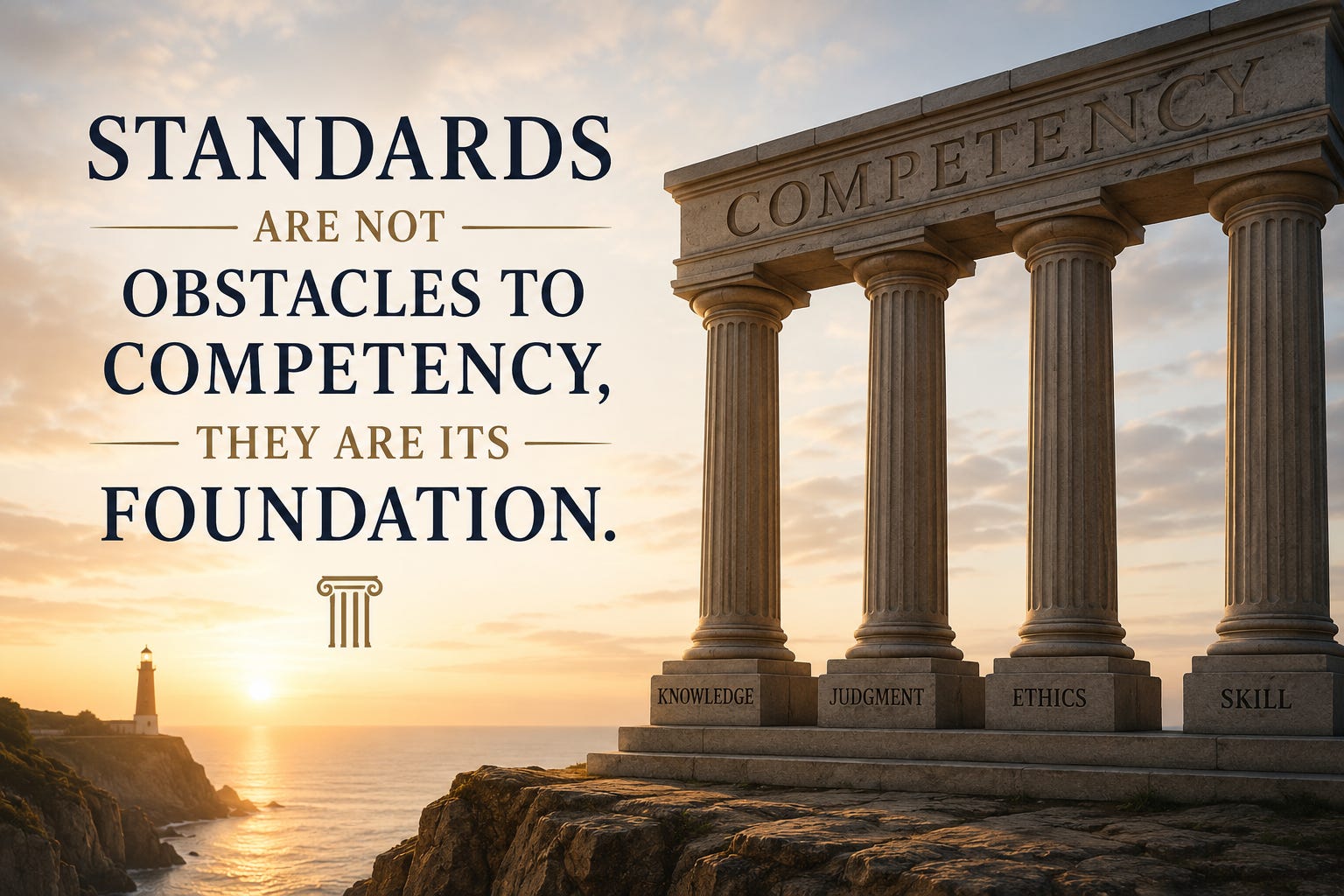
Meaningful standards are not barriers to success; they are the foundation of competency and public trust.

A recent debate within the University of California system offers a powerful lesson for every institution that has weakened or removed objective measures of readiness. Hundreds, and by some reports more than 1,100 UC faculty members, especially in the science, technology, engineering and math (STEM) fields, have urged UC leaders to restore the SAT or ACT mathematics requirement for applicants to STEM majors. Their concern is not abstract or ideological. It is practical: too many students are arriving without the foundational math skills necessary to succeed in college-level science, technology, engineering, economics, and related fields (The Wall Street Journal, June 2026; Los Angeles Times, May 27, 2026).
The faculty letter makes a crucial point: eliminating a test does not eliminate the underlying preparation gap. It merely hides it until it appears later in the classroom, where the cost is greater. According to reports from UC San Diego, the percentage of incoming students requiring remediation in elementary or middle-school mathematics reportedly increased from 0.5 percent in 2020 to 8.5 percent in 2025 (The Wall Street Journal, June 2026). Faculty also warned that current admissions tools, grades and essays, have become less reliable in an era of grade inflation and AI-assisted writing.
That is the central implication:
Standards do not create deficiencies; they reveal them.
Removing the instrument of measurement may temporarily make a system look more inclusive or efficient, but it does not make students more prepared, bridges more stable, pilots more competent, or therapists more clinically sound.
The analogy to mental health licensure is direct.
California removed the LMFT oral examination in 2003. Since then, the profession has relied increasingly on written examinations to determine readiness for independent clinical practice. I had the privilege of serving the California Board of Behavioral Sciences (BBS) as an Oral Examiner from 1994 through 2003, giving me first-hand experience in evaluating beginning therapists seeking licensure. Alongside another trained examiner, I learned through extensive training by the BBS to distinguish between candidates who had demonstrated clinical competence and those who had not. Like the many experienced clinicians who served as oral examiners, I viewed our role as the profession’s final gatekeepers in protecting the public and ensuring that they would be well served with, at least, competent therapists.
Historically, approximately 65 percent of candidates did not pass the oral examination, meaning they had not demonstrated the minimum level of clinical competence required for independent practice at that time. Once the oral examination was eliminated in California, as well as eventually throughout the country, that final live assessment of clinical readiness disappeared.
Written examinations can measure knowledge, but they cannot adequately assess real-time clinical judgment, ethical reasoning, therapeutic presence, crisis response, or the ability to organize and apply treatment under pressure. The oral examination was not an arbitrary hurdle; it was the state’s only direct measure of whether a candidate could actually demonstrate minimum competency before serving the public.
The UC faculty are essentially saying: “We need a reliable way to know whether students are ready before placing them into demanding academic environments.”
The Board of Behavioral Sciences should be asking the same question at an even higher level of consequence:
“Do we have a reliable way to know whether candidates are ready before placing them alone with vulnerable clients?”
The stakes in psychotherapy are not merely academic. Therapists deal with suicidal ideation, domestic violence, child abuse, trauma, marital collapse, addiction, severe mental illness, and families in crisis. A licensing system that never directly observes a candidate’s clinical reasoning is like a university admitting STEM students without knowing whether they can do basic algebra, or like granting a driver’s license without a road test.
This is not an argument against access. It is an argument for honest access.
The UC faculty letter demonstrates that failing to measure preparation gaps does not remove barriers; it simply moves them into the classroom. In mental health, failing to measure clinical readiness does not protect candidates; it moves the risk into the therapy room.
That is why reinstating some modern form of oral examination, virtual, structured, shorter, rubric-based, and carefully calibrated, is not a return to the past. It is the logical next step in restoring competency-based standards. A written examination can remain valuable, just as grades still matter in admissions. But neither should be the only measure when the real-world demands require performance, judgment, and applied skill.
The deeper lesson is simple:
Meritocracy and competency cannot survive if institutions become afraid to measure readiness. Compassion does not require lowering standards. It requires helping people meet them.
True fairness is not pretending everyone is prepared. True fairness is holding everyone to the same meaningful standard while providing every qualified individual the opportunity to demonstrate competence.
The UC controversy is a warning.
When standards are removed in the name of convenience or ideology, the deficiencies do not disappear. They simply reappear later, often in more damaging forms. California’s mental health licensing system should learn from that warning now.
Before we build more programs, task forces, or initiatives to increase access, we must first strengthen the front door of the profession. The recent call by more than 1,100 University of California STEM professors to restore the SAT and ACT for admissions recognizes an important principle: meaningful standards are not barriers to success; they are the foundation of competency and public trust.
Likewise, I will continue encouraging the California Board of Behavioral Sciences, and ultimately licensing boards and legislators across the nation, to reinstate a modern, virtual oral examination as an essential component of the licensure process. Doing so will better protect the public, strengthen the integrity of our profession, and ultimately serve candidates by providing them the opportunity to demonstrate the clinical judgment, ethical reasoning, and interpersonal competence that written examinations alone cannot measure.
More to come.
Access without competence is not compassion. It is risk disguised as reform.
The content of this article is offered for educational and reflective purposes only. It is not therapy, counseling, legal advice, or individualized mental health care. The ideas and perspectives presented are intended to encourage thought and discussion, or merely entertainment, not to replace professional guidance tailored to your specific circumstances. Even though your comments are greatly appreciated by myself as well as other readers, I may not be able to respond to all of them. Reading this article does not create a therapeutic relationship. If you are experiencing significant emotional distress or are in crisis, please seek support from a competent licensed mental health professional or appropriate local support services.